
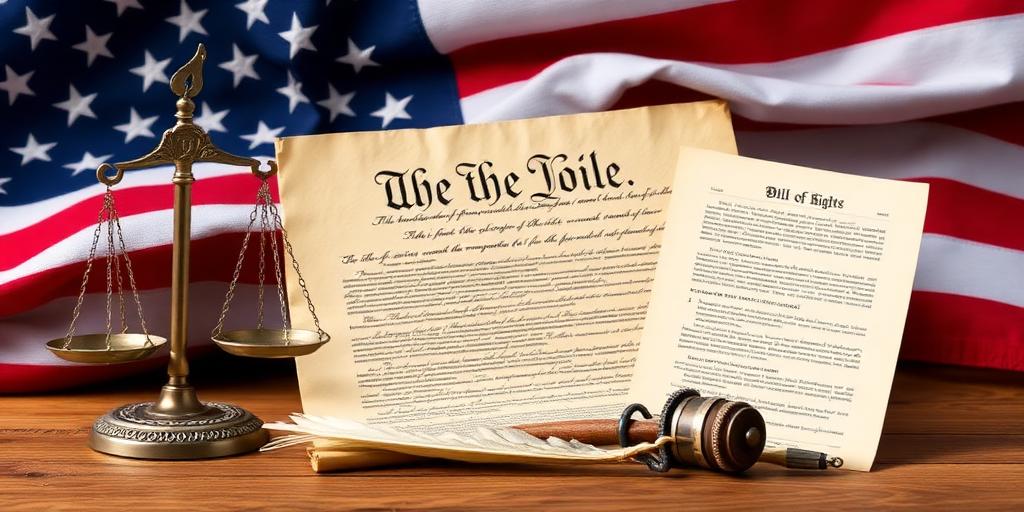
The United States Constitution stands as the supreme law of the nation, a framework meticulously crafted to balance governmental power and individual liberties. Ratified in 1788, it establishes a system of checks and balances among the legislative, executive, and judicial branches, ensuring no single entity becomes overly dominant. This foundational document, along with its subsequent amendments, provides the bedrock for American jurisprudence and civic life.
The genesis of the Constitution lies in the inadequacies of the Articles of Confederation, the first governing document of the newly formed United States. The Articles, adopted in 1777, created a weak central government with limited authority to regulate commerce or levy taxes, leading to significant economic and political instability. Recognizing these shortcomings, delegates from twelve of the thirteen original states (Rhode Island abstained) convened in Philadelphia in 1787 to revise the Articles. However, the delegates, led by figures such as James Madison, Alexander Hamilton, and Benjamin Franklin, ultimately decided to draft an entirely new Constitution.
The Constitution is structured into seven articles, each delineating specific aspects of the federal government's operation:
- Article I: The Legislative Branch: Establishes the structure and powers of Congress, which consists of the Senate and the House of Representatives. It details the qualifications for members, the process for enacting laws, and the enumerated powers of Congress.
- Article II: The Executive Branch: Defines the powers and responsibilities of the President, including the power to execute laws, command the military, and make treaties. It also establishes the Electoral College, the mechanism for electing the President.
- Article III: The Judicial Branch: Creates the Supreme Court and authorizes Congress to establish lower federal courts. It defines the jurisdiction of the federal courts and guarantees the right to a jury trial in criminal cases.
- Article IV: Relations Among the States: Addresses the relationship between the states and the federal government, including the Full Faith and Credit Clause, which requires states to respect the laws and judicial decisions of other states.
- Article V: Amendment Process: Outlines the procedure for amending the Constitution, ensuring that it can adapt to changing societal needs and values. Amendments can be proposed by a two-thirds vote of both houses of Congress or by a convention called by two-thirds of the states.
- Article VI: Supremacy Clause: Declares the Constitution and federal laws to be the supreme law of the land, superseding state laws when there is a conflict.
- Article VII: Ratification: Specifies the process for ratifying the Constitution, requiring the approval of at least nine of the thirteen original states.
The Bill of Rights, comprising the first ten amendments to the Constitution, guarantees fundamental rights and freedoms to all citizens. These rights include:
- First Amendment: Freedom of speech, religion, the press, assembly, and the right to petition the government.
- Second Amendment: The right to bear arms.
- Third Amendment: Protection against quartering soldiers in private homes.
- Fourth Amendment: Protection against unreasonable searches and seizures.
- Fifth Amendment: Protection against self-incrimination and double jeopardy; guarantee of due process of law.
- Sixth Amendment: The right to a speedy and public trial.
- Seventh Amendment: The right to a jury trial in civil cases.
- Eighth Amendment: Protection against excessive bail and cruel and unusual punishment.
- Ninth Amendment: The enumeration of specific rights in the Constitution does not mean that other rights not specifically listed are not also protected.
- Tenth Amendment: Powers not delegated to the federal government by the Constitution, nor prohibited to the states, are reserved to the states or the people.
The Constitution and the Bill of Rights are living documents, continuously interpreted and applied by the courts in response to evolving societal norms and challenges. Landmark Supreme Court cases, such as Marbury v. Madison (1803), which established the principle of judicial review, and Brown v. Board of Education (1954), which declared state-sponsored segregation in public schools unconstitutional, demonstrate the Constitution's enduring relevance and adaptability.
Understanding the Constitution and the Bill of Rights is essential for informed citizenship and active participation in a democratic society. These documents not only define the structure of our government but also safeguard the fundamental rights and freedoms that are the cornerstone of American liberty. Continuing study and engagement with these principles are crucial for preserving and strengthening our constitutional republic.


