
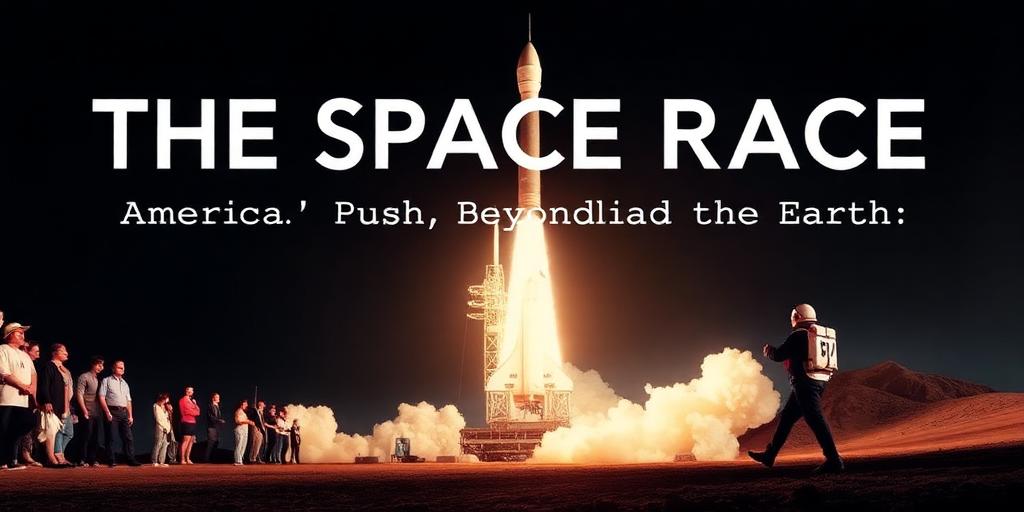
The Space Race, a Cold War-era competition between the United States and the Soviet Union, was a pivotal period in human history, marked by unprecedented technological advancements and a relentless pursuit of supremacy beyond Earth's atmosphere. This article delves into the key events, figures, and technological breakthroughs that defined America's ambitious push into space.
The Genesis of the Space Race
The launch of Sputnik 1 by the Soviet Union on October 4, 1957, ignited the Space Race. This event sent shockwaves across the United States, triggering concerns about technological and military inferiority. In response, President Dwight D. Eisenhower established the National Aeronautics and Space Administration (NASA) in 1958, consolidating various research efforts under a single civilian agency.
Key Milestones in America's Space Journey
- Project Mercury (1958-1963): America's first human spaceflight program aimed to learn if humans could survive in space. Astronauts like Alan Shepard, who made the first American suborbital flight on May 5, 1961, and John Glenn, the first American to orbit the Earth on February 20, 1962, became national heroes.
- Project Gemini (1965-1966): This program focused on developing spaceflight techniques to support the Apollo program, including extravehicular activity (EVA) and rendezvous and docking procedures. Gemini astronauts demonstrated the ability to maneuver in space and perform complex tasks.
- Project Apollo (1961-1972): Driven by President John F. Kennedy's audacious goal of landing a man on the Moon before the end of the decade, Project Apollo remains one of humanity's greatest achievements. On July 20, 1969, Neil Armstrong and Buzz Aldrin became the first humans to walk on the Moon, fulfilling Kennedy's vision and solidifying America's lead in the Space Race.
Technological Innovations and Their Impact
The Space Race spurred rapid advancements in rocketry, materials science, computing, and telecommunications. These innovations not only enabled space exploration but also had profound impacts on various aspects of civilian life.
- Microchips: The demand for lightweight and efficient computing systems for spacecraft led to the development of microchips, revolutionizing electronics and paving the way for the modern computer age.
- Materials Science: The need for heat-resistant materials for spacecraft re-entry led to breakthroughs in materials science, resulting in new alloys and composite materials used in aerospace, automotive, and other industries.
- Satellite Technology: The Space Race accelerated the development of satellite technology, leading to advancements in communication, weather forecasting, and navigation systems.
The Legacy of the Space Race
The Space Race concluded with the Apollo-Soyuz Test Project in 1975, symbolizing a thaw in Cold War tensions. However, its legacy continues to shape space exploration today. The technological advancements, scientific knowledge, and human capital generated during this period laid the foundation for future missions to Mars and beyond. The spirit of innovation and competition that defined the Space Race remains a driving force in the ongoing quest to explore the cosmos.
In conclusion, America's push beyond Earth during the Space Race was a transformative endeavor that not only propelled humanity to new frontiers but also left an indelible mark on science, technology, and society. The lessons learned and the innovations achieved during this era continue to inspire and inform our exploration of the universe.


